CCTV Before Sewer Lining: What the Inspection Can and Cannot Prove
How to turn a pre-lining camera survey into a useful rehabilitation scope, with clear records of defects, visibility limits, dimensions, connections, and unanswered engineering questions.
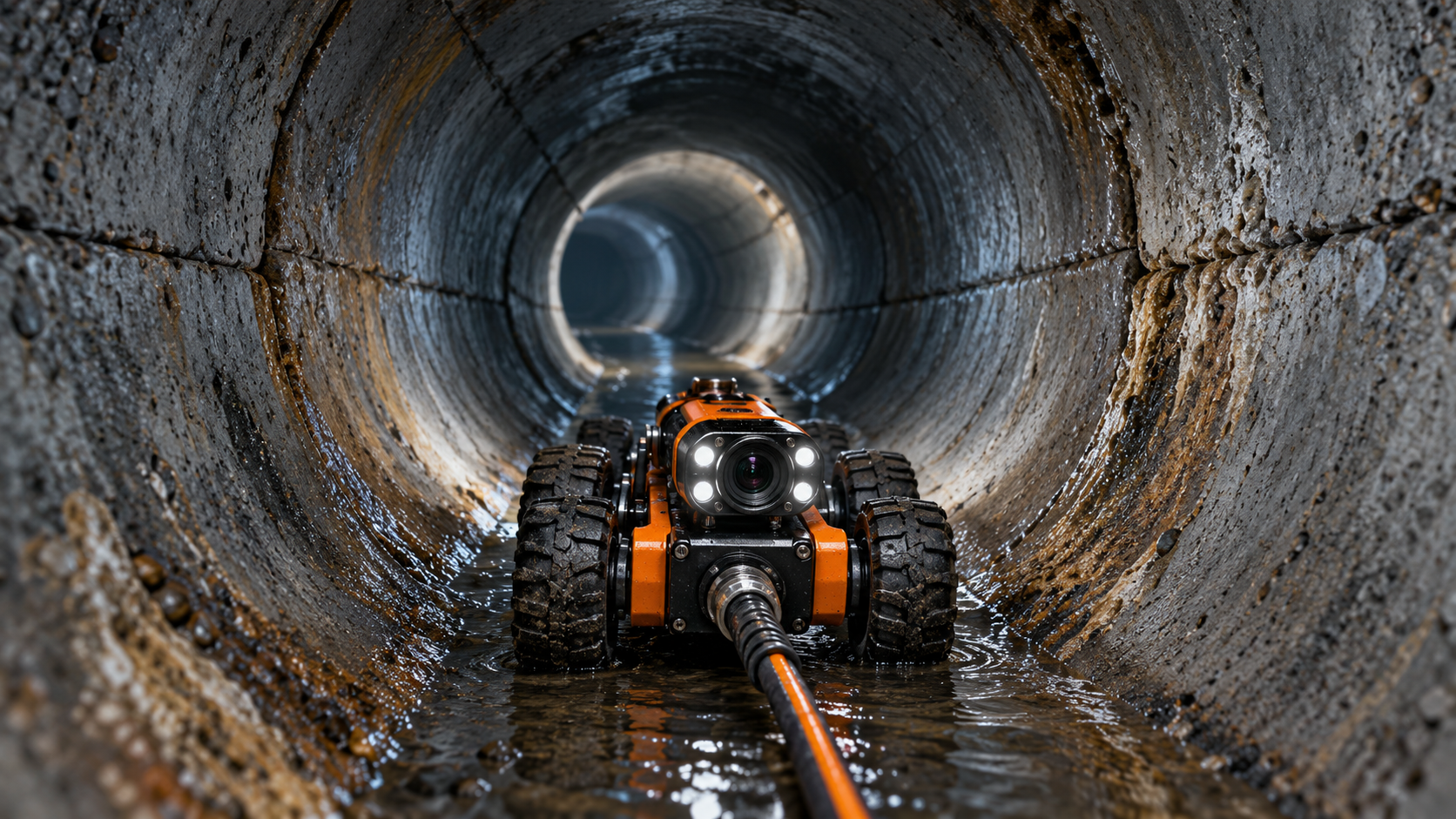
A camera survey can show the inside of a sewer clearly enough to make the next decision seem obvious. Roots, open joints, deposits, or a damaged invert appear on screen, and the conversation quickly turns to a lining proposal. The useful next step is to ask which questions the survey actually answered.
This guide concerns pre-rehabilitation inspection of gravity sewers. Pressure mains and other pipeline services need assessment methods suited to their own materials, operating conditions, access, and failure consequences. No camera image, by itself, establishes that a particular coating or structural liner is suitable.
Start with an identifiable asset
A usable survey connects the footage to the correct pipe segment. The report should identify the upstream and downstream access points, inspection direction, date, pipe material, dimensions, and the distance reference used in the recording. Resolve conflicting asset names before the video is used to prepare a scope.
Ask for the original footage and the coded report, rather than relying only on selected still photographs. A close-up of a defect is easier to interpret when the reviewer can see how it sits within the surrounding pipe and follow its location along the segment.
Make visibility part of the finding
A camera can only document what its view allows. Flow, deposits, lens contamination, poor lighting, and obstructions can hide the surface or limit how far the equipment travels. A report should distinguish a clear inspection from a partial view and identify sections that were not inspected.
NASSCO’s guidance on CCTV inspection quality emphasizes matching the equipment setup to pipe diameter, material, and flow conditions. That preparation supports useful structural and operational coding. It also explains why the quality of the recording deserves review before its condition ratings become the basis of a bid.
If cleaning or flow management is needed for a better view, have the responsible contractor and system operator plan it safely. Do not assume a blocked or submerged section is sound simply because no defect was recorded there.
Use consistent descriptions, then make the engineering decision
Standardized coding helps different reviewers describe observations in a consistent way. NASSCO’s assessment resources explain the role of condition information in planning rehabilitation. A common vocabulary is valuable when surveys from different contractors or years are compared.
Keep the distinction between the observation and the proposed solution. A recorded crack, displaced joint, or visible infiltration is evidence to evaluate. Selecting a repair, determining structural requirements, and judging whether the host pipe can support a proposed system remain design decisions that need the relevant project information.
Know what ordinary CCTV leaves unanswered
A conventional video view shows accessible internal surfaces. It does not directly measure remaining wall thickness or reveal the supporting ground outside the pipe. Water can obscure the lower portion. A visual record also should not be treated as a precise dimensional survey unless the inspection includes an appropriate measurement system.
The EPA’s condition-assessment white paper describes those limits of traditional CCTV. It is an older technology review, so its equipment descriptions should not be mistaken for an inventory of today’s systems. The underlying lesson still matters: identify the measurement capability actually included in the commissioned survey.
Where the design depends on wall loss, shape, deformation, or another property that the video does not establish, ask the engineer what additional investigation is needed. Newer cameras, laser profiling, sonar, and other methods are different tools with their own limits. Naming a technology is only useful if it answers a defined question.
Map connections and details before lining
Record service connections, changes in section, bends, previous repairs, protrusions, and other features that affect access or installation. Identify which connections are active and who will verify them. A lining plan needs to account for how the system continues to serve the properties connected to it.
Turn the observations into a location-based issue list. For each item, record whether it requires cleaning, further investigation, a local repair, a design decision, or another agreed action before lining. Leave unresolved items visible. A contractor cannot price a hidden assumption consistently.
Do not let a clean video replace coating inspections
A post-cleaning survey can help document visible condition. It does not automatically verify every surface-preparation requirement of a spray-applied system. The specified cleanliness, surface profile, moisture condition, environmental limits, and repairs still need the appropriate checks.
Likewise, an attractive post-installation video cannot establish all the finished lining’s required properties. Thickness, continuity, cure, adhesion, and structural performance need the tests or evidence specified for that particular system. Plan access and acceptance methods before work starts, especially where the finished surface will be difficult to reach.
Leave the review with a bounded conclusion
A useful conclusion says which segment was inspected, what could be seen, what was found, and what remains unknown. It names the additional decisions required before installation. That is more actionable than an unsupported statement that the pipe is “ready for lining.”
The camera survey earns its value when it makes the rehabilitation scope clearer. Treat it as a documented part of the assessment, and carry its limitations forward into design, bidding, and quality control.
General educational information. A qualified design professional and the asset owner should establish the assessment and rehabilitation requirements for the specific pipeline.
Put this to work on real pipe.
Whether you want to spray pipeline coatings or need a line coated, one short form gets you to the right person.